
Human-Centred Design (HCD) in Customer Experience: A Practical Guide for CX Leaders
Human-Centred Design (HCD) is one of the most important disciplines in modern customer experience (CX) — yet it is also one of the most misunderstood.
Too often, organisations treat HCD as a workshop, a sticky-note exercise, or a softer alternative to operational decision-making.
In reality, good HCD is rigorous. It helps teams understand real customer needs, define the right problem, and design solutions that work for customers, frontline employees, and the business.
The value of HCD is simple: it reduces the risk of solving the wrong problem.
Instead of jumping straight into ideas, technology, or process changes, Human-Centred Design forces a better sequence — first understand what customers and employees are actually experiencing, then define the real issue, and only then explore and test solutions.
Done well, it improves customer outcomes, employee experience, operational efficiency, and commercial performance at the same time.
Why HCD matters in CX
It helps you stop designing around internal assumptions and start designing around real customer needs, behaviours, and friction points.
What makes it powerful
It combines empathy, evidence, iteration, and measurement so improvements are meaningful, practical, and measurable — not just well-intentioned.
What this guide covers
The HCD definition, the Double Diamond framework, practical CX applications, common pitfalls, how to measure success, FAQs, and ACXPA resources.
What is Human-Centred Design?
Human-Centred Design is an iterative problem-solving approach that puts people at the centre of design and decision-making.
In practice, that means starting with a deep understanding of the people you serve — their needs, behaviours, context, pain points, and goals — before deciding what should be changed or built.
In customer experience, that shift is critical. Many organisations still start with internal assumptions such as "we need a chatbot", "we need to reduce call volumes", or "we need to redesign the app".
HCD challenges that instinct. It asks whether those are actually the right responses — or whether the underlying issue sits elsewhere in the journey, the process, the policy, the product, or the operating model.
At its best, HCD is not just about empathy. It is about disciplined problem definition.
It combines customer insight, frontline feedback, qualitative research, quantitative data, and iterative testing to ensure teams are solving meaningful problems in ways that work in the real world.
In plain English
Human-Centred Design means understanding the real problem from the human point of view before committing to a solution.
✓ What HCD is
- A structured way to understand people and context
- A framework for defining the right problem
- A process for exploring and validating solutions
- A discipline that reduces waste and rework
- Evidence-backed, outcome-measured improvement work
✕ What HCD is not
- Just a brainstorming workshop
- Design for design's sake
- Guessing what customers want
- A substitute for measurement or business rigour
- A softer alternative to operational decision-making
Why Human-Centred Design Matters in Customer Experience
Customer experience work often fails in a predictable way. Teams identify a symptom — high call volumes, poor NPS, repeat contacts, complaints, drop-off, low digital adoption — and immediately move into solution mode.
A new channel is launched. A process is automated.
A script is rewritten. A survey is redesigned.
But if the underlying problem was never properly understood, the "solution" either underperforms or creates new friction elsewhere. That is where HCD matters.
It slows the team down just enough to ask better questions: What are customers actually trying to achieve?
Where is the friction really coming from? What are frontline employees seeing that dashboards are not showing?
For CX teams, Human-Centred Design is especially valuable because customer experience problems are rarely isolated.
A poor outcome may involve channel design, policy, staffing, product information, self-service content, hand-offs, and escalation logic all at once. HCD helps teams look at the whole system — not just one touchpoint.
For CX leaders
HCD improves the quality of strategic decisions by making sure effort is focused on the highest-value problems, not the most visible symptoms.
For contact centre leaders
It helps distinguish between avoidable demand, process failure, policy friction, and training or quality issues before investing in the wrong fix.
For service designers
It provides a practical structure for balancing customer needs, employee realities, operational feasibility, and business outcomes simultaneously.
The Double Diamond Framework Explained
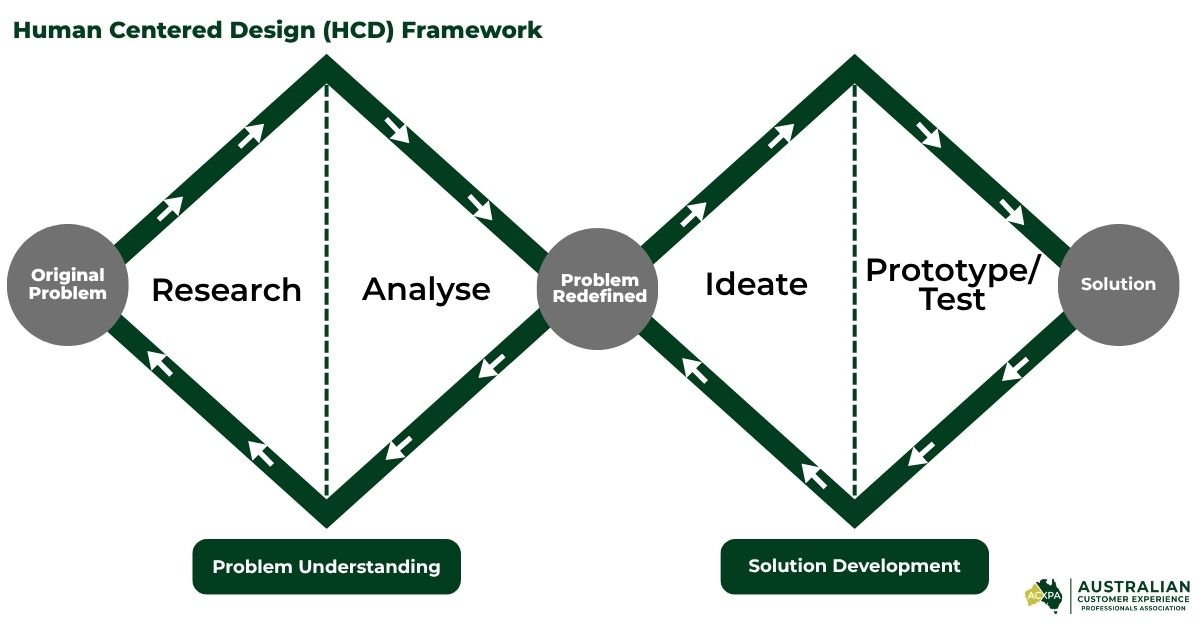
The most recognised model for Human-Centred Design is the Double Diamond. It provides a simple but powerful structure for how teams should think: first about the problem, then about the solution.
In each diamond, teams first diverge to explore broadly, then converge to narrow focus and make decisions.
This matters because poor CX decisions usually come from collapsing those two activities into one.
Teams start narrowing before they have explored widely enough, or they keep exploring without ever converging into a clear decision. The Double Diamond forces a better rhythm.
Discover
This is where teams explore the current reality. The goal is not to validate an existing idea, but to understand the customer, the employee experience, the context, and the evidence.
In CX, that may include interviews, complaints analysis, journey reviews, call listening, observation, operational data, and frontline input.
Define
This is where insight is synthesised into a clear problem statement.
The strongest teams do not just summarise themes — they define what problem matters most, why it matters, who it affects, and how success should be measured. Weak problem definition is where most HCD work goes wrong.
Develop
Only once the problem is clear should teams explore possible solutions.
This is where ideation, co-design, concept development, process options, prototypes, and future-state designs come into play. The key is to generate options before locking in one answer too early.
Deliver
This stage focuses on testing, refining, implementing, and learning. In strong CX practice, that means validating what works in reality — not just what looked good in a workshop or presentation.
Pilots, prototypes, controlled rollouts, QA checks, operational measures, and feedback loops all belong here.
The most important transition
The biggest failure point in HCD is the jump between Discover and Define. If the problem is framed poorly, even a well-executed solution can still fail to deliver meaningful results.
HCD Framework Diagram
The Double Diamond is useful because it makes the discipline of HCD visible.
It reminds teams that customer experience improvement is not just about generating ideas — it is about moving deliberately from understanding, to definition, to solution development, to delivery.
Below is the ACXPA HCD framework diagram. Members can access an enhanced CX-focused version with richer prompts, outputs, and practical guidance for each stage.
How to Apply Human-Centred Design in Customer Experience
HCD becomes genuinely valuable when it is applied to real operational and customer challenges — not treated as a theoretical design process detached from the day-to-day running of the business.
In CX, that means using Human-Centred Design to tackle the issues that actually shape customer outcomes: effort, confusion, repeat contact, poor hand-offs, avoidable complaints, digital failure demand, and broken journeys across channels.
The strongest CX teams use HCD to connect insight with action.
They combine customer research with operational evidence, bring frontline employees into the process, size the problem, test ideas before scaling, and measure whether the change actually improved the experience and the business result.
Contact Centres
Use HCD to uncover the real causes of repeat contact, transfers, escalations, avoidable demand, and complaints — before defaulting to more scripting, more training, or more automation.
Journey Improvement
Use it to diagnose where journeys break across channels, teams, and systems — especially valuable when pain sits between departments rather than within one area.
Digital and Self-Service
Apply HCD before launching or expanding self-service, bots, knowledge content, or app features. Otherwise you risk digitising a broken experience instead of improving it.
Complaints and Recovery
Use HCD to understand not just why complaints happen, but why resolution journeys feel hard, inconsistent, or emotionally poor — even when the issue is technically resolved.
Practical HCD questions for CX teams
- What is the customer actually trying to do?
- Where is the friction really coming from?
- What does the frontline know that leadership may not see?
- What evidence shows this is a high-value problem to solve?
- How will we know if the change genuinely worked?
Benefits of Human-Centred Design in CX
When Human-Centred Design is applied properly, it improves far more than the customer journey map.
It improves decision quality, helps teams focus investment where it matters, and brings customer, employee, operational, and commercial thinking into the same conversation.
It also creates stronger alignment between what customers need and what the organisation can realistically deliver.
Better customer outcomes
Solutions are more relevant because they are grounded in real needs, not internal assumptions about what customers want or experience.
Reduced project risk
Teams validate the problem before investing heavily in the answer — reducing the risk of building the wrong solution at scale.
Stronger ROI
Effort is focused on higher-value friction points, not cosmetic fixes that look good in a presentation but don't move the needle for customers.
Better cross-functional alignment
HCD creates a shared understanding of what is wrong and what success looks like — reducing the internal friction that slows CX improvement work.
Improved employee experience
Frontline teams are brought into the process, which often reveals practical issues quickly and increases buy-in for the resulting changes.
More sustainable change
Solutions are tested and refined rather than rolled out on confidence alone — leading to changes that stick and continue to deliver value over time.
Common Pitfalls and Challenges in HCD
Despite its strengths, HCD is easy to misuse. In many organisations, the language of Human-Centred Design is adopted faster than the discipline itself.
Teams talk about empathy and ideation, but still skip evidence, rush definition, or fail to measure outcomes. That turns HCD into theatre rather than a serious improvement method.
Jumping to solutions
The biggest failure point. Teams decide on the answer before they have properly understood the problem — then wonder why the solution underperforms.
Ignoring scale and impact
Qualitative insights are valuable, but they should be paired with data so teams know how big the problem is and where it matters most.
Confusing workshops with progress
A productive workshop is not the same as a validated problem statement or a tested solution. Output from a workshop is a starting point, not an outcome.
Excluding frontline voices
Some of the best evidence in CX sits with the people serving customers every day. Ignoring that perspective is a serious miss that consistently produces worse outcomes.
Weak measurement
If you cannot show what changed, for whom, and by how much, the HCD initiative has not been fully completed — regardless of how good the process felt.
Over-designing the concept
Some teams spend too long perfecting the idea and not enough time validating whether it works operationally. Iteration beats perfection every time.
How to Measure the Success of Human-Centred Design Initiatives
This is where many HCD discussions become weak — focusing heavily on insight and ideation, then becoming vague when asked whether the work actually improved anything.
In CX, that is not good enough. Human-Centred Design should be measurable, and measurement should be built in from the start, not bolted on at the end.
Link the initiative to a business KPI
Be explicit about what outcome should improve.
That could be NPS, complaints, conversion, first contact resolution, repeat contact rate, churn, customer effort, digital completion rate, or cost to serve. Name it before you start.
Size the problem using quantitative data
Do not rely on stories alone. Pair customer insight with data to understand scale, frequency, risk, and financial or operational impact.
This turns a qualitative finding into a business case.
Use contact centre and service data properly
Call reasons, complaint categories, transfers, rework, wait times, survey results, quality results, and channel shifts can all help validate what is really happening — and size how much it matters.
Bring analysts into the process
Designers and CX leads should not have to do all the quantification alone. Strong HCD benefits from analytical capability, especially when multiple data sources need to be connected.
Measure before, during, and after
Set a baseline before change, track pilot performance, and continue measuring after implementation so the team learns what actually moved the needle — not just what felt like it worked.
Simple rule
Good HCD is insight-led, but it should always be evidence-backed and outcome-measured.
Frequently Asked Questions About Human-Centred Design in CX
What is Human-Centred Design in customer experience?
Human-Centred Design in CX is an approach that starts by understanding customer and employee needs, behaviours, context, and friction before designing solutions.
It helps teams improve experiences based on evidence rather than assumption — reducing the risk of solving the wrong problem.
What is the Double Diamond model?
The Double Diamond is a framework commonly used in HCD. It consists of four stages — Discover, Define, Develop, and Deliver — and reflects the discipline of diverging to explore broadly and converging to make decisions.
The first diamond focuses on understanding and defining the right problem; the second focuses on developing and delivering the right solution.
Why is HCD important in customer experience?
It helps organisations solve the right problems, not just the visible symptoms.
Teams that skip to solution mode too quickly often end up building things that don't address the real cause of customer pain — leading to poor ROI and recurring issues.
HCD prevents that by forcing better problem definition upfront.
Is Human-Centred Design the same as design thinking?
They are closely related but not always used in exactly the same way. In practice, HCD is often used to emphasise designing around real human needs and contexts, while design thinking is sometimes used as a broader umbrella term.
The underlying principles — empathy, problem definition, ideation, prototyping, and testing — are very similar in both approaches.
What is the biggest mistake teams make with HCD?
Jumping to solutions before clearly defining the problem. Once a team locks onto the wrong problem, even a strong solution can fail to deliver meaningful results.
The Define stage of the Double Diamond — where insight is synthesised into a clear, specific problem statement — is where the most value is created or lost.
Can HCD be used in contact centres?
Absolutely. Contact centres are one of the best places to apply HCD because they provide rich customer insight, frontline knowledge, and operational data all in one place.
HCD is particularly useful for tackling avoidable demand, complaints, call drivers, service failures, and broken processes — helping leaders understand the root cause before investing in a fix.
How do you measure whether HCD worked?
The same way you measure any serious CX initiative: define the intended KPI before you start, establish a baseline, size the problem with data, track pilot results, and monitor outcomes after implementation.
If you cannot point to a metric that moved, the work is not complete.
How does HCD relate to Customer Journey Mapping?
Customer Journey Mapping and HCD are complementary disciplines. Journey mapping is often used within the Discover and Define stages of the Double Diamond to build a clear picture of the current customer experience.
HCD then provides the framework for what to do with that insight — how to define the right problem, develop solutions, and deliver and measure improvements. See the ACXPA glossary term for Customer Journey Mapping for more.
Where to Next
Final Thoughts: Why Human-Centred Design Matters in CX
Human-Centred Design is not just a design technique. It is a better way of thinking about customer experience improvement.
It helps organisations get closer to the reality of what customers and employees are dealing with, define better problems, reduce wasted effort, and build solutions that work in practice — not just in workshops.
For CX leaders, the real power of HCD is not that it makes teams more creative. It is that it makes them more precise.
It forces better questions, sharper decisions, stronger prioritisation, and more confidence that the work being done will actually improve outcomes.
If your organisation wants to improve customer experience in a meaningful and measurable way, Human-Centred Design is one of the strongest foundations you can build on.