
Dealing with Anger and Abuse in Customer Service
Violence, threats and abuse are no longer rare edge cases in customer service — they're becoming disturbingly common across retail, contact centres and frontline roles. Cost-of-living pressure, long waits and broken processes all raise the temperature, and staff are increasingly on the receiving end.
Anger and abuse aren't the same thing, and they don't call for the same response. Anger is about the problem, and most of it can be de-escalated. Abuse is directed at your people — and that needs a firm line and a clear process.
This guide covers why anger escalates so quickly, practical steps to reduce it, and — just as importantly — how to protect your people when it tips into abuse.
Abuse is rising
Frontline teams across retail and contact centres are facing more anger, threats and abuse than ever.
Most escalation is preventable
A calm, capable response de-escalates. A defensive or scripted one pours fuel on the fire.
Protect your people
Take care of your people so they can take care of your customers — that starts with clear boundaries.
Why Anger Escalates So Quickly
Most customers who reach a frontline team are already frustrated before anyone says a word. They've waited, repeated themselves, been bounced between departments, or been let down by a process that didn't do what it promised. Add financial stress and fatigue, and the fuse is short.
At that point, the interaction can go one of two ways. A calm, confident response — where the customer feels genuinely heard and sees someone taking ownership — brings the temperature down. A defensive, robotic or dismissive response confirms their worst fear: that no one is going to help. That's when anger escalates, and occasionally tips into abuse.
There's neuroscience behind this. Under stress, the brain's older "survival" wiring can override the rational, problem-solving part — the fight, flight or freeze response. A customer in that state genuinely finds it harder to think clearly, regulate emotion or take in information, which is why logic alone rarely calms someone down.
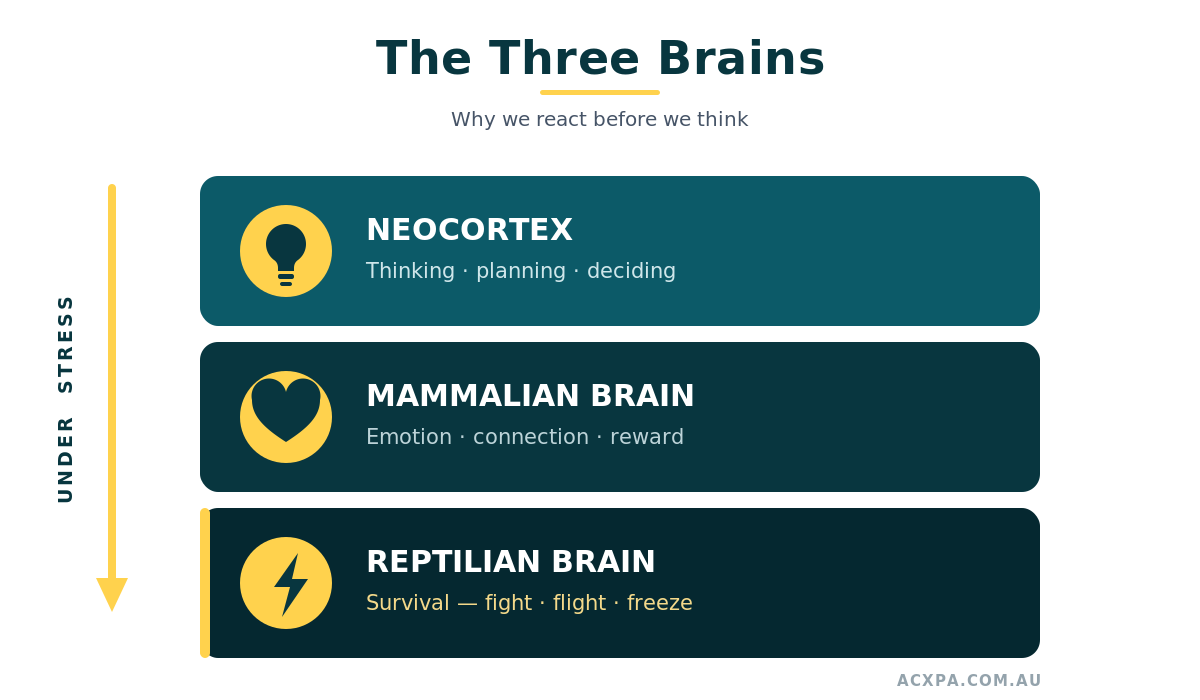
Under stress, control drops from the thinking neocortex to the survival-driven reptilian brain — which is why an upset customer can't just be reasoned with, and why staying calm yourself is what actually de-escalates.
The distinction that matters
Anger is a reaction to a problem — and it's usually recoverable. Abuse is aimed at the person in front of the customer. The first you de-escalate; the second you must have a clear line for.
Practical Steps to Reduce Anger
De-escalation isn't about being a pushover — it's about staying in control of yourself and the conversation. A repeatable structure helps agents respond well under pressure instead of reacting.
Hear them out
Let the customer say their piece without interrupting. Being heard is often most of what an angry customer actually wants.
Empathise, genuinely
Acknowledge how they feel before you talk solutions. A real empathy statement lowers the temperature; a scripted one raises it.
Own it and act
Take responsibility for putting it right — even if the cause wasn't yours — and be clear about what happens next and when.
Set honest expectations
Over-promising to end an awkward call just creates a second, angrier one. Be clear about what you can and can't do.
A structured approach like the HEAT model — Hear, Empathise, Apologise, Take action — gives agents a framework to fall back on, and having ready phrases for common situations means they're never scrambling for words in the heat of the moment.
🎓 Build de-escalation skills across your team
The CX Skills Managing Difficult Customers course gives frontline staff a practical, repeatable de-escalation toolkit for exactly these situations — and ACXPA members save 25%.
Protecting Your People When It Tips Into Abuse
De-escalation has limits. When a customer becomes threatening, abusive or unsafe, the priority shifts from resolving the issue to protecting your staff. Every organisation needs a clear, consistent answer to "what happens now?" — so the decision doesn't rest on a stressed individual in the moment.
Clear zero-tolerance messaging
Make it visible and unambiguous that abuse of staff isn't tolerated — and back it with a process agents are empowered to use.
Don't leave people exposed
Avoid staff working alone where possible, ensure rapid back-up is available, and add security measures in higher-risk environments.
Empower agents to end it
Give staff explicit permission — and the words — to warn a customer and then end an abusive contact. Nobody should feel they must absorb abuse to keep a metric happy.
Support people afterwards
Provide structured support for staff who experience abuse. A quick "you okay?" isn't enough — build in real follow-up and wellbeing support.
The bottom line
Take care of your people, so they can take care of your customers. Staff who feel protected and supported handle pressure far better than staff who feel exposed.
Training Helps — But Systems Matter Too
Training frontline staff to manage difficult situations is essential — but training alone isn't enough. Poorly designed complaints processes, unclear escalation paths and inconsistent decisions increase frustration and significantly raise the risk of anger escalating into abuse.
Organisations that combine strong frontline skills with clear complaints frameworks reduce repeat conflict, shorten resolution times and create safer environments for staff. Customer service has never really been about whether people care — it's about how well they manage themselves, and their systems, under pressure.
Skills and systems, together
Pair de-escalation training with a consistent complaints handling process. Skilled people working inside a broken system still burn out; good systems make good skills repeatable.
Frequently Asked Questions
How do you deal with an angry customer?
Let them be heard, empathise genuinely with how they feel, take ownership of putting it right, and be clear about what happens next. Staying calm and in control of yourself is what de-escalates the situation — reacting defensively is what escalates it.
What's a good acronym for dealing with angry customers?
HEAT — Hear, Empathise, Apologise, Take action — is a widely used, easy-to-remember framework. It gives agents a repeatable structure to fall back on under pressure. See our full guide to managing angry customers with the HEAT model.
What's the difference between an angry customer and an abusive one?
Anger is a reaction to a problem and is usually recoverable through de-escalation. Abuse — threats, slurs, intimidation or violence — is directed at the person. Anger you work to resolve; abuse you should have a clear line and process for ending.
When should staff end an interaction with an abusive customer?
When a customer becomes threatening, abusive or unsafe. Staff should be explicitly empowered to warn the customer and then end the contact. A zero-tolerance policy — backed by a clear process — protects your people and removes the burden of that decision from a stressed individual.
How do you protect frontline staff from abuse?
Visible zero-tolerance messaging, avoiding lone working where possible, rapid back-up and security in higher-risk settings, clear escalation, permission to end abusive contacts, and structured support for staff who experience abuse.
Does training reduce customer abuse?
Training helps staff manage difficult situations, but it works best alongside clear complaints processes and escalation paths. Skills and systems together reduce repeat conflict far more effectively than either alone.
Where to Next
Summary
Anger and abuse in customer service are rising, but they aren't the same challenge. Most anger is preventable and recoverable — a calm, capable, genuinely empathetic response de-escalates the majority of it. Abuse is different: it's aimed at your people, and it needs a firm, clear line rather than more patience.
The organisations that get this right pair strong de-escalation skills with clear systems — consistent complaints processes, defined escalation paths, visible zero-tolerance policies, and real support for staff who are on the receiving end. Look after your people, and they'll look after your customers.
Related Articles


- About Me
- View My Articles
- View Full Article Library

Jaquie Scammell is Australia’s leading customer service expert, CEO and Founder of ServiceQ.